Sunrise & Sunset
How to tell if a sunset will be colorful
A fire sky isn’t luck. It’s geometry — a long, grazing path of light, clouds at the right height, and a bright edge that sweeps overhead and is gone in minutes.
It starts with the light path. At sunrise and sunset the sun sits low, so its light reaches us along a long, grazing path through the atmosphere — many times farther than the near-vertical path at midday. The longer that path, the more of the blue and green is scattered away along the way, until only the deep reds and oranges survive to light up the clouds overhead. Low sun, long path, red light: that’s the whole first act.
The role of cloud height
Clouds act as a screen for that reddened, low-angle light. Sit too low or hang too thick and the colour never reaches them; at the right altitude, with clear air toward the horizon, they catch fire. Height matters more than it seems: because the light skims the curve of the Earth, a cloud base just a few kilometres up can be lit by sunlight that entered the atmosphere hundreds of kilometres away — over the horizon, where the sky at your feet has already gone dark.
And it’s a direction, not just “the horizon”. The path that matters runs from where you stand, out along the bearing where the sun is actually rising or setting — its azimuth. That bearing is only due east or west near the equinox; the rest of the year the sun comes up and goes down well to the north or south of it, drifting with the season and your latitude. So when we say “clear air toward the horizon”, we mean toward that line specifically: it’s the cloud and clarity along the sunrise/sunset azimuth, traced outward from your own location, that make or break the show.
Which clouds are most likely to catch fire
Not every sky can burn. The ones with the best odds tend to share a couple of traits:
- Mid and high clouds — a few kilometres up and higher (the rippled “alto” patches and wispy cirrus). Low, thick, uniform decks usually just block the light.
- Texture and gaps — broken, patchy or rippled clouds catch the raking light on their edges and undersides far more dramatically than a flat grey overcast.
Why it sweeps, and why it’s brief
A fire sky isn’t one frozen picture. As the sun drops, the band of reddened light rakes across the cloud deck and along the ground — the lit region has a definite shape that moves and narrows. That’s why the colour builds, peaks for a few minutes, and fades: you’re watching a moving edge, not a switch. Being in place a little early is everything.
The geometry of a fire sky — the maths
1. The light grazes a curved Earth. The reach of a fire sky is a matter of geometry more than chemistry. Treat the lower atmosphere as a thin shell of radius \(R\) (Earth’s radius, ~6,371 km) and follow a ray that just skims the surface at your feet. Put the origin at that tangent point, with \(h\) measured straight up and \(l\) measured horizontally along the ground. A little trigonometry on the circle gives the ray’s height above the curved surface:
$$ h(l) = \frac{R}{\cos(l/R)} - R. $$
The distances that matter — a few hundred kilometres — are tiny next to \(R\), so the angle \(l/R\) is small and that secant flattens into a parabola:
$$ h(l) \approx \frac{l^{2}}{2R}. $$
That one approximation is the whole trick. Invert it and you get how far away the sunlight lighting a given cloud must have entered the air:
$$ l \approx \sqrt{2Rh}. $$
For a cloud base a few kilometres up, \(l\) comes out to hundreds of kilometres. The clouds burning over your head are lit by sunlight that crossed the atmosphere far over the horizon — where someone standing beneath them is already in twilight. That is why a fire sky so often peaks after your local sunset, and why clear air toward the horizon matters more than clear air straight overhead.
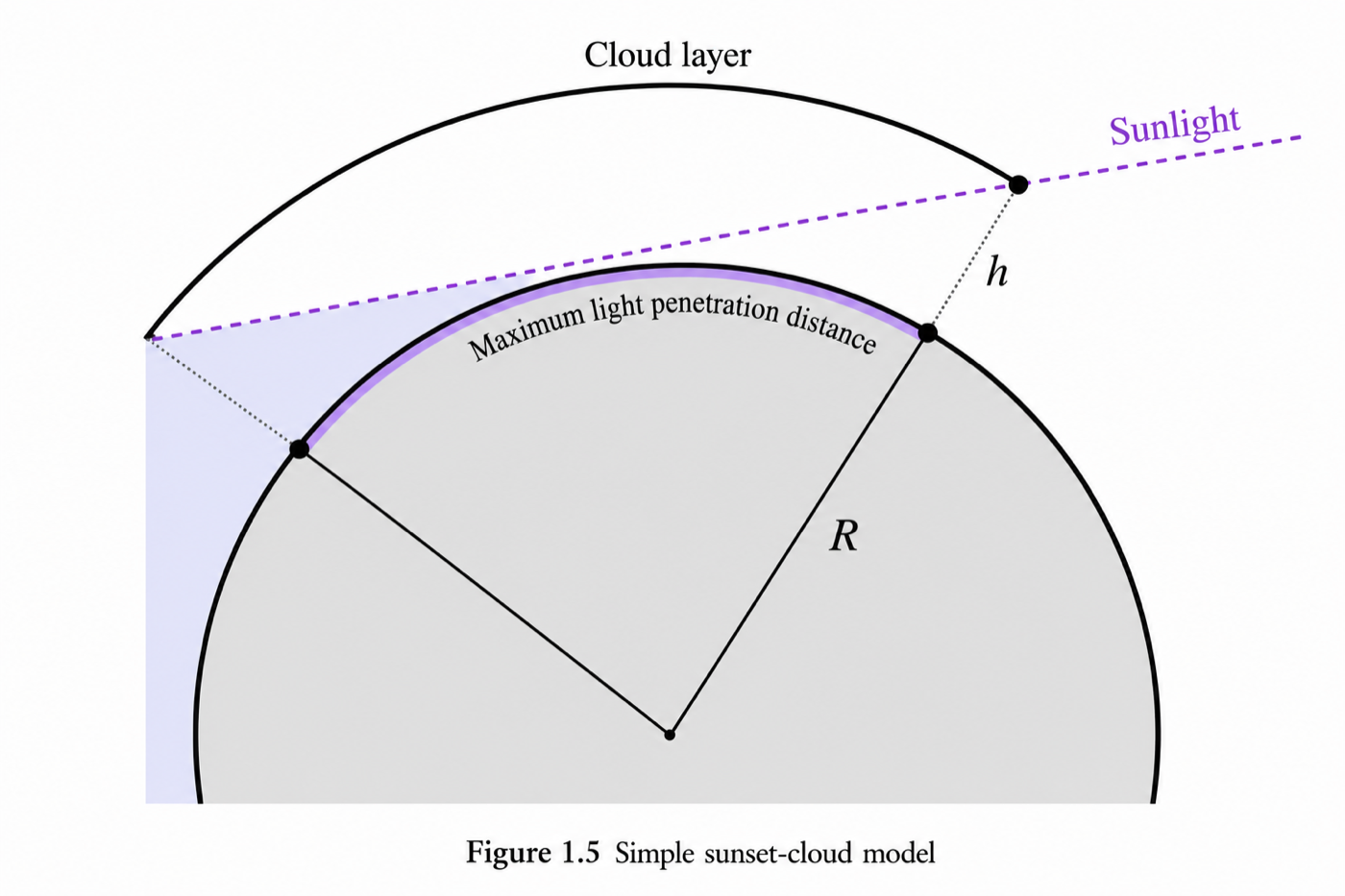
2. The light doesn’t enter at the tangent point. In practice the grazing ray crosses into the shell off to one side, so the useful parabola is shifted by an offset \(l_{0}\):
$$ h(l) \approx \frac{(l - l_{0})^{2}}{2R}. $$
The offset \(l_{0}\) is set by the sun’s elevation. This is what ties the colour to the exact minute: nudge the sun’s angle and you slide \(l_{0}\), and the entire lit region slides with it.
3. Why it sweeps, and why it’s brief. As the Earth turns, the sun’s elevation angle \(\varphi\) falls at a nearly steady rate, so the “sunset line” — the edge of the lit region — races across the ground at a speed
$$ v = R\,\left|\frac{d\varphi}{dt}\right|, $$
which works out to hundreds of metres per second. The band of reddened light isn’t switched on and off; it is a fast-moving edge sweeping over the cloud deck. Any given patch of cloud sits inside that band for only a few minutes — it brightens, peaks, and goes dark as the edge passes. That is the entire life of a fire sky, and the reason being in place a little early is everything.
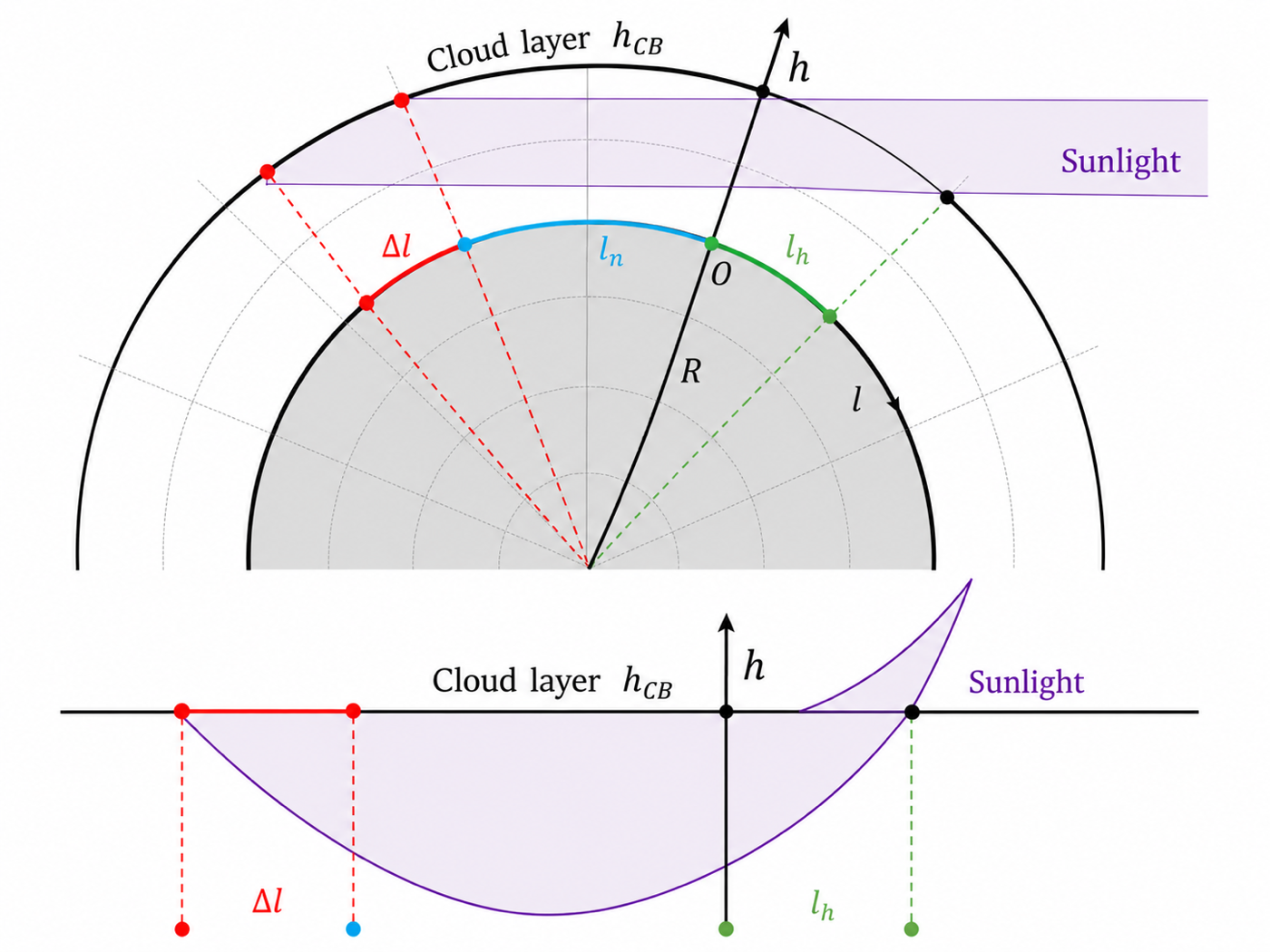
This is the geometry our Sunset & Sunrise model runs on — the same path‑length and sweep calculation, evaluated per grid cell for the exact place and minute.